Telling the Story of Flight: Between Cinema, Literature, and Reality
There’s something about flight that never stops fascinating us.
It’s not just about engines or technicalities—it’s about a dream: ever since humans first looked to the sky, we’ve longed to cross it. And that desire, long before the cockpit, was born on the pages of books and in the frames of films.
Literature has portrayed flight as freedom, adventure, and poetry. Consider Antoine de Saint-Exupéry, pilot and writer, who in Night Flight turned crossing the clouds into a metaphor for life and courage. Or his Little Prince, where the journey between planets becomes a journey within oneself.
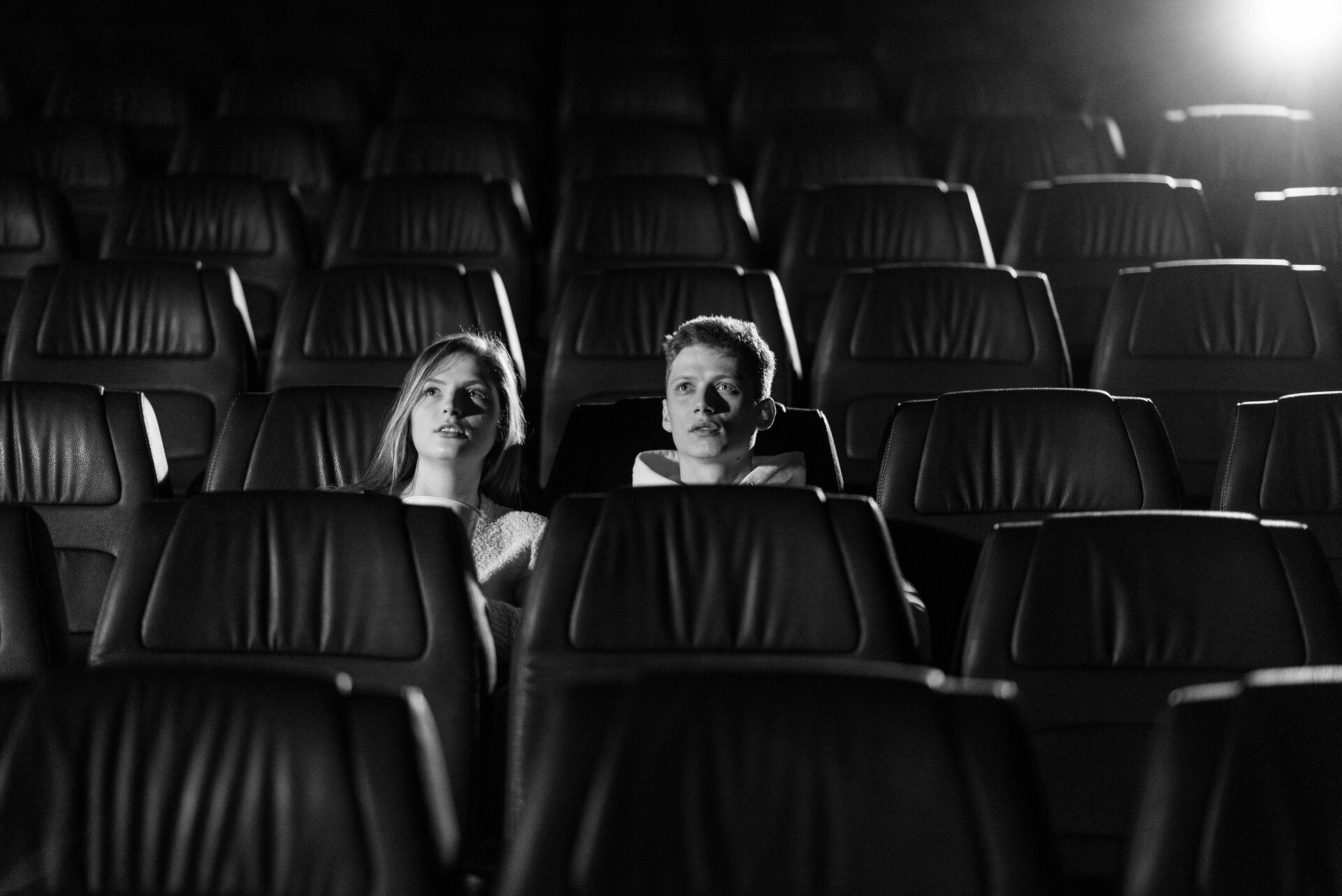
Cinema, in turn, has made flight spectacle and emotion. From the adrenaline of Top Gun to the inner strength in Sully, which reconstructs an impossible landing turned legend, to the poetic imagery in Wim Wenders’ The Wings of Desire. Every film shows us that flying is never just “transport”: it’s always a challenge, a risk, a promise of freedom.
Yet the fascination with flight doesn’t live only in the stories we read or watch—we can experience it firsthand. Flight simulators exist for precisely this reason. They are not just tools for professional training, but also gateways to those emotions. Stepping into the cockpit, gripping the controls, facing a night takeoff or a crosswind landing—experiences that echo the wonders of literature and cinema, but with a touch of reality.
This blog was created to tell the story of flight in all its forms: through books, films, and the stories of those who have truly crossed the sky. It will be a journey through culture and technique, imagination and simulation, guided by a single compass: a passion for flying.
Flying is not just moving through space: it’s a way of seeing life from a new perspective. If cinema and literature have taught us to dream it, simulators give us the chance to live it firsthand.
Here,
every story
can become an experience,
every emotion
can transform into flight.
Night Flight: When Literature Crosses the Clouds
One can master the sky without knowing how to tell its story, and master words without knowing how to fly.
Antoine de Saint-Exupéry could do both, and that made him unique.
Each of his books is a human journey that takes us into the solitude of the sky, the struggles of pioneers, and the poetry that flight preserves.
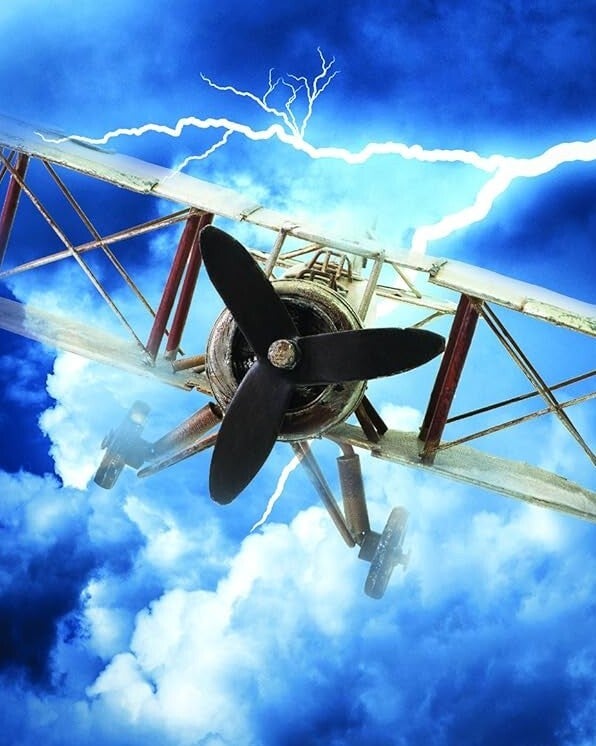
In Night Flight, perhaps his most intense book, Saint-Exupéry takes us into the cockpit alongside airmail pilots—men alone facing darkness, storms, and the constant risk of not returning. It is human fragility confronted with the power of the sky.
What strikes us even today is how he transforms flight into metaphor: takeoff is always a choice, crossing the clouds is an obstacle to overcome, and landing is a return to oneself. Every reader, even without ever having touched a yoke, finds in those pages their own fears, courage, and nights.
This is why reading Saint-Exupéry means discovering the most intimate side of flight: not the maneuvers, but the emotions. At the same time, for those now taking the controls of a simulator, it is possible to relive those atmospheres. A night flight through turbulence and silence—even digitally recreated—can immerse us in the same world described in those pages.
The sky of Night Flight has never been closer.
From the Book to the Simulator
Imagine taking off at dusk, when the sky darkens and the horizon disappears. The city lights fade behind you, leaving only darkness ahead. This is the classic scenario of Night Flight.
With our simulator lessons, you can relive those same sensations in a modern setting:
-
Night takeoff from a major international airport.
-
Navigation through clouds and turbulence, relying on modern onboard systems.
-
Cockpit management, making the experience faithful to that of a real airline pilot.
An experience that is not only technical, but also emotional: a bridge between the literary visions of Saint-Exupéry and the reality of today’s aviation.
Top Gun: The Myth of the Pilot Between Cinema and Reality
Some films belong to their time, and some transcend it, leaving a mark on collective memory as symbols.
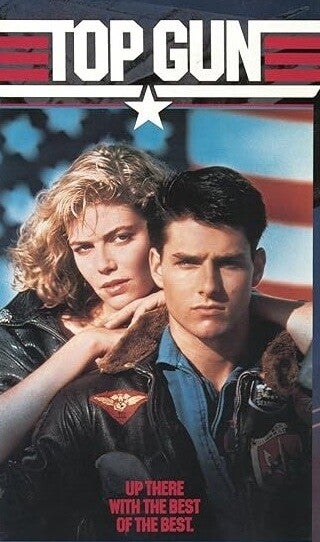
Top Gun, released in 1986, belongs to the latter category. It wasn’t the first film to depict fighter pilots, nor the first to show military life. Yet it touched chords beyond mere spectacle, becoming a global cultural phenomenon.
The images of jets slicing through the sky, the roar of engines that becomes almost music, the intensity of skill competitions, and the lightheartedness of scenes on the ground—all contributed to building a new imagination, one that spoke to everyone, not just aviation enthusiasts. Cinema, with its visual power, turned flying into something more: an aesthetic, emotional, almost mythological experience.
Watching Top Gun in the 1980s meant entering a dimension of pure energy. The characters were young, charismatic, bold, yet vulnerable. There was the desire to excel, the tension of competition, the need to demonstrate courage. Maverick, the protagonist, embodied the eternal struggle between talent and discipline, instinct and rules. In that tension, the audience recognized themselves: flying became a metaphor for something we all, deep down, understand.
Behind the cinematic lights, however, lies reality. Flying is not just spectacle; it’s not continuous aerobatics or one-upmanship. It is rigorous study, daily training, responsibility. The pilot is not a lone hero, but part of a crew, a system requiring attention and cooperation. Top Gun made us dream of skies on fire at sunset, but real aviation reminds us that behind every takeoff are hours of planning, and behind every landing is the focus of an entire team.
It is precisely this contrast that keeps it fascinating today. On one side, the myth, with its sunglasses and immortal soundtrack; on the other, reality, made of checklists, instruments, and rapid yet measured decisions. Two different worlds, yet they meet at one point: the human desire to confront the sky.
From the Film to the Simulator
What does it mean today to approach that imagery? No military jets or aircraft carriers are needed. Sitting in a flight simulator is enough to realize that the experience of piloting retains the same aura of challenge and discovery.
With the Airbus A320, the star of our simulator, the dream shifts from aerial combat to airline flying. It’s a different experience, but no less intense. Here, it’s not about beating an opponent, but confronting the sky and oneself.
Takeoff: Whether by day or night, each runway roll becomes a moment suspended in time. Instruments align, indicators reset, and only the horizon opens ahead.
Navigation: Through clear skies or cloud banks, concentration focuses entirely on instruments and route management. It is here that one discovers that flying is mostly discipline and constant attention.
Landing: Perhaps the most anticipated moment, when the runway appears ahead, and every action, every check becomes crucial. Here, the simulator best conveys the thrill of precision and the weight of decisions.
The simulator does not provide the cinematic adrenaline of acrobatic turns, but something equally valuable: the chance to experience the cockpit as a real pilot, to connect with the rhythm of flight, and to feel focus and excitement build as the journey progresses.
In this sense, Top Gun is not just a cinematic memory but an invitation. It reminds us that flight, in all its forms, is an experience that goes beyond the limits of possibility: on screen, it excites us; in reality, it tests us; and in the simulator, it allows us to approach that timeless dream of mastering the sky, authentically and safely.
.
Amelia Earhart: The Courage to Write and Fly
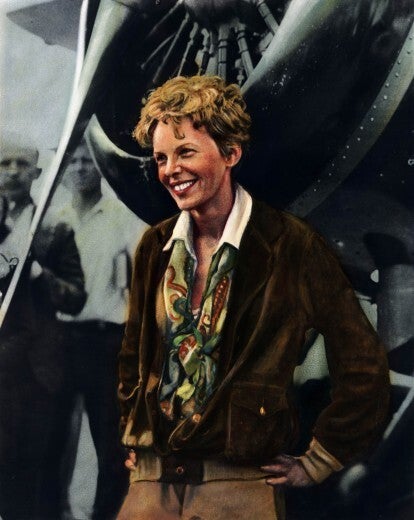
Some figures belong to aviation history, and others transcend it, becoming universal symbols. Amelia Earhart is both. Pilot, pioneer, writer, and the first woman to fly solo across the Atlantic—her life was a tapestry of skies and words, extraordinary feats and intimate reflections.
Born in 1897, at a time when flying was an adventure reserved for a few daring men, Amelia chose not to accept limits. Her goal was not just to traverse the air, but to prove that a woman could do it with the same determination, skill, and courage. And she did, breaking records, achieving milestones, and inspiring generations.
But Amelia was more than an aviator. She wrote books and diaries recounting her relationship with the sky, with freedom, with fear. Her writings reveal a human side, full of enthusiasm and fragility, joy in accomplishments, and awareness of risks. For her, flight was a way to explore the world, but also to tell its story. Every route became a page, every landing a chapter, every storm a symbol.
Her disappearance in 1937 during an attempt to circumnavigate the globe turned her into a legend. The mystery surrounding her final flight has only fueled the myth: Amelia is not just a name in aviation history, but an icon of freedom, courage, and independence.
Rereading her words today is to encounter a woman who, through flight, spoke about life. “Flying may not only teach you about the vastness of the world, but also its fragility,” she wrote. A phrase that still resonates every time we look at the sky and wonder what it truly means to cross it.
From Diary to Simulator
Sitting in a modern simulator like the Airbus A320 does not replicate Amelia’s flights, but it can help us understand her passion.
Facing a long route evokes the sense of adventure: hours of navigation testing endurance and time.
Managing changing weather conditions gives a sense of how the sky is always an unpredictable companion.
Landing after a night flight becomes an experience of trust—in the instruments, in your abilities, and in the sheer beauty of flying itself.
Amelia said, “The best way to do something is to stop talking and start doing.” In this sense, the simulator becomes a bridge: from the written page to concrete experience, from past legend to the opportunity to feel, today, the wonder of flight.